The Physical Edge AI Revolution
Why 2025 is the inflection point for intelligent hardware — and what imply+infer is building.
We Are at an Inflection Point
Two exponential curves are finally converging, creating the biggest opportunity in computing since the smartphone.
Software is Shrinking
Edge-optimized inference models are collapsing in size while retaining accuracy. Qwen3, Gemma3, YOLOv12 — these models run locally with remarkable capability.
Hardware is Exploding
100x TOPS increase in 3 years. Massive gains in RAM density, power efficiency, and GPU compute. Edge devices now rival 2020-era data center capabilities.
This convergence means one thing: AI is leaving the cloud and entering the physical world. Robots, drones, smart cameras, autonomous vehicles, industrial sensors — all of these are becoming intelligent at the edge.
The Scale of the Opportunity
The numbers tell the story. Physical edge AI is not a niche — it's becoming the dominant paradigm for intelligent systems.
Non-datacenter edge AI hardware (2025)
Projected growth (McKinsey/Gartner)
NPU-enabled devices by 2028
Every industrial robot, every autonomous vehicle, every smart security system, every agricultural drone — they all need local AI inference. The cloud is too slow, too expensive, and too unreliable for the physical world.
The Hidden Bottleneck
Here's what nobody tells you about edge AI: the hardware is ready, but the developer experience is stuck in the 1990s.
$50k–$250k Burned
Per prototype, on engineers fighting CUDA, kernel, and driver issues instead of building product.
2-6 Weeks Lost
Just making the hardware boot reliably before a single model runs.
Project Death
Most edge AI projects die in "integration hell" before reaching production.
"We spent weeks setting up our Jetson Orin. The hardware is incredible, but getting everything working together was a nightmare. It's a major reason our robotics platform is delayed."
The pattern repeats across the industry: teams waste months on driver roulette, kernel version mismatches, and custom patches for every camera and sensor. This friction is killing innovation at the exact moment when the technology is finally ready.
What imply+infer is Building
We're building the usability layer for physical AI — making 100-TOPS hardware actually ship. Our approach combines pre-hardened hardware kits with intelligent software that eliminates the integration nightmare.
- ✕Hardware FragmentationWeeks of sourcing parts, 3D printing, and assembly
- ✕Software Nightmare100+ steps to install CUDA, compile drivers, fix dependencies
- ✕Wasted Time40–120 hours burned before running a single model
- ✓All-in-One Field KitComplete, rugged workstation. Unbox and start building.
- ✓Pre-Configured OSBootable NVMe with Ollama, PyTorch, and vision stack ready.
- ✓Immediate ValueFrom unboxing to running advanced AI models in minutes.
Our Technology Stack
AI Driver Synthesis
Generates kernel drivers and device tree overlays automatically. What used to take days now takes minutes.
Cross-Architecture Middleware
IOMMU-based abstraction layer that works across Jetson, Qualcomm, Rockchip, and x86 platforms.
Peripheral Virtualization
Secure plug-and-play for cameras, sensors, and actuators. Auto-detection, auto-configuration.
Hardened Field Kits
Production-ready AI hardware with pre-installed models, offline-first architecture.
Jetson Orin Nano Field Kit
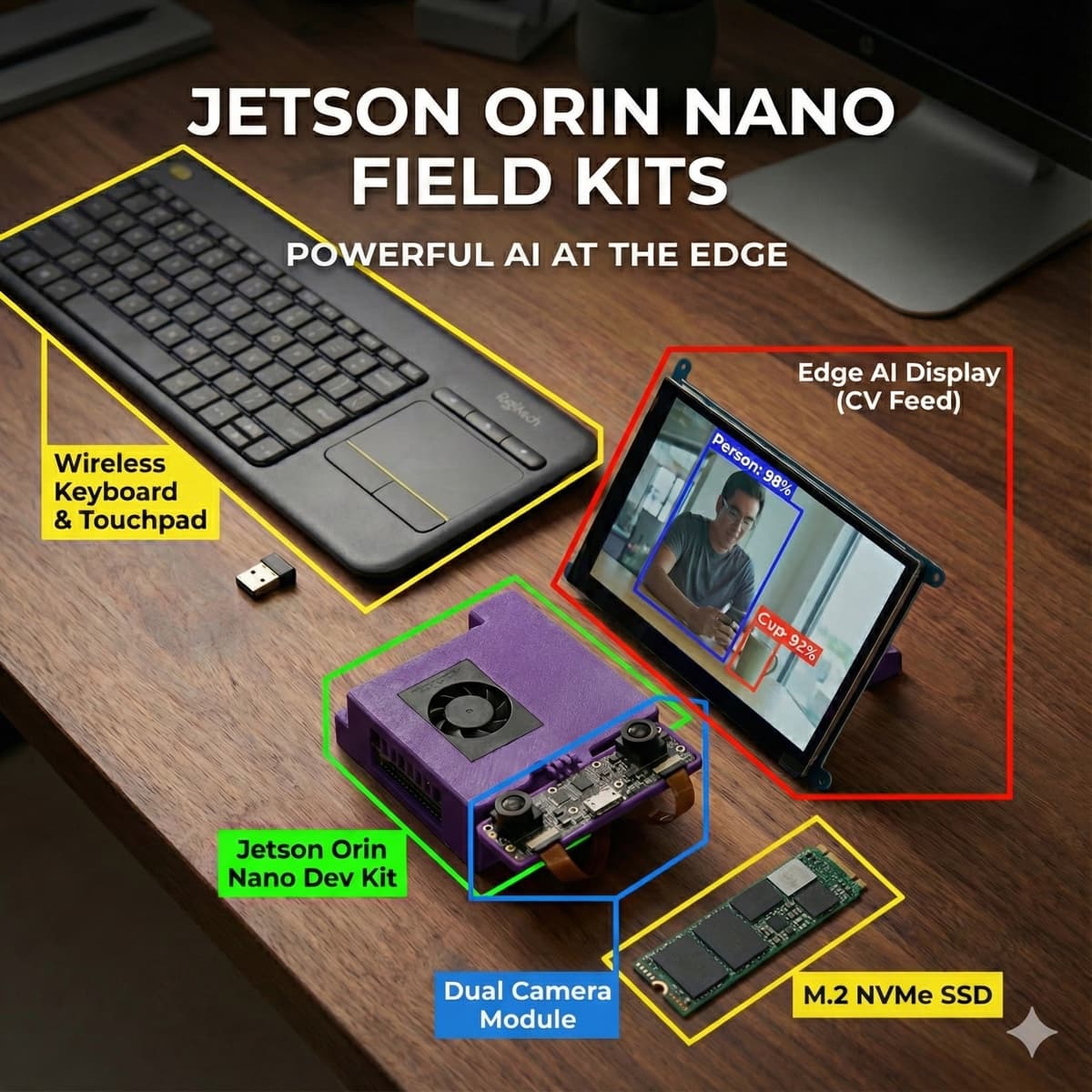
Our flagship product is the Jetson Orin Nano Field Kit — a complete, ready-to-deploy edge AI workstation. Think of it as the "Raspberry Pi moment" for professional AI hardware.
Complete Edge AI Workstation
Starting at $799 — everything you need to go from idea to prototype in hours, not months.
- ✓100 TOPS AI Performance
- ✓Pre-installed LLMs & Vision Models
- ✓Stereo Depth Perception
- ✓Useable Out-of-the-Box
Moving Up the Stack
Field kits are just the beginning. Our roadmap takes us from solving the immediate pain point to becoming the standard infrastructure layer for physical AI.
The "Golden Image"
Solving the Setup Pain
- • Field Kits: Validated hardware reference designs
- • OS Layer: Pre-compiled kernels, drivers, & AI stack
- • Result: Unbox to inference in < 1 hour
The Usability Layer
Pickaxes for the AI Rush
- • Driver Synthesis: AI-generated device tree overlays
- • Auto-Discovery: Plug-and-play sensors & cameras
- • Result: Enabling the next 1,000 hardware startups
The Edge AI Cloud
Solving Fleet Scale
- • Fleet Ops: OTA updates & config management
- • Hardware Agnostic: Abstracting the silicon entirely
- • Result: The standard OS for physical AI
Early Signals
We're still early, but the signals are strong. Teams that try our kits don't go back to building from scratch.
"Saved us 4 months of dev time on day one. The first time our vision stack just worked."
"We spent weeks trying to setup our Jetsons for our fleet. imply+infer solved it in 30 minutes."
Average dev time saved per device
Boot-to-inference time
Our Thesis
We believe the next decade belongs to physical AI. Not chatbots in the cloud, but intelligent systems that see, hear, and act in the real world. Robots that assemble products. Drones that inspect infrastructure. Vehicles that navigate autonomously. Cameras that understand context.
But this future only happens if we solve the usability problem. The hardware is ready. The models are ready. What's missing is the bridge — the developer experience that makes edge AI as easy to deploy as a web app.
That's what we're building at imply+infer.
"Plug in. Infer anywhere."
About imply+infer
Aaron Landy, Founder
4x founder with experience scaling engineering at Uber (infrastructure for 100M+ rides). Helped build assistant-ui (YC W25 & 100K+ weekly npm downloads) and shipped $1M+ ARR developer tools. Spotted the edge AI pain point early and founded imply+infer to solve it.
Strategic Partners
Get in Touch
imply+infer: Plug in. Infer anywhere.